A bionic ear

cochlear implant processor

My two criteria for a new solution to help my hearing and comprehension were met:

  • probable significant improvement
  • little risk of balance and vertigo problems

There was a third requirement, given that I could not afford the great expense of the  implant itself, the surgical fee, the hospitalization fees and the rehabilitation fees. More on that in a moment.

A little help from my friends

I have no family members, no acquaintances with a cochlear implant. I asked medical and audiological personnel for references. Four people kindly agreed to discuss with me their own experiences.

Naturally, I was referred to people who experienced at least a modicum of success in using a cochlear implant. Keeping this in mind, I heard for myself the limits these people experienced. They ranged from someone whose implant completely changed his life (for the better) to someone who needed her husband to help out during telephone conversations. In short, cochlear implants result in a range of experiences. I asked each person my “bottom-line” question: Given what you know now, would you do it again? 100% in the affirmative.

I already knew from reading that cochlear implant results vary tremendously. The main benefit to me of discussing with these kind people was the positive emotional energy that they imparted. If my two primary decision criteria were logical in nature, my exchanges with other users helped me to feel good about my decision.

The cochlear implant

For those who are not familiar with the cochlear implant, I will briefly describe it. The device consists of two main components.
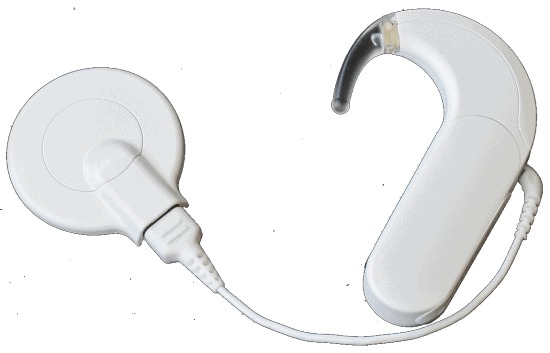
Cochlear Implant-external component
The external component of a cochlear implant. Photo by Thomas.haslwanter - Own work, CC BY-SA 4.0, https://commons.wikimedia.org/w/index.php?curid=47220627

An external component has one or more microphones, a digital signal processor and an antenna. Multiple microphones allow for a certain sense of directionality in the sound captured. The digital signal processor converts the analogical signal from the microphones into digital signals. It transforms those signals to enhance their comprehensibility by the brain. The antenna transmits the signals through the skin to the internal component of the device. It is held in place by a magnet that attracts an internal magnet.
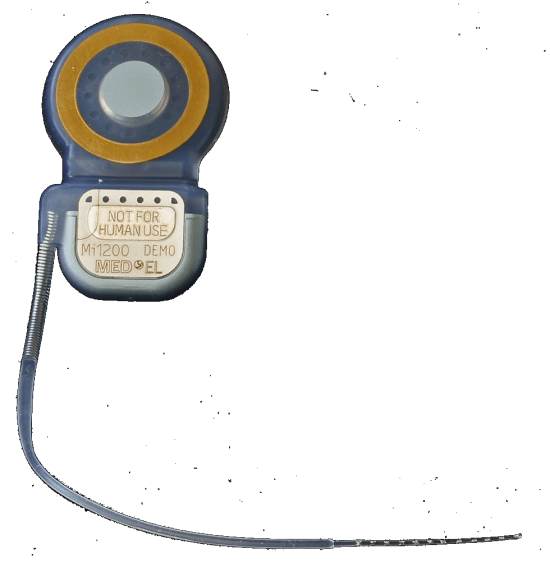
Cochlear Implant-internal component
The internal component of a cochlear implant. Photo by Thomas.haslwanter - Own work, CC BY-SA 4.0, https://commons.wikimedia.org/w/index.php?curid=47220627


The internal component consists of a second antenna, another signal processor and a set of 20 some-odd wires (the number varying according to the model). The second antenna is inserted by a surgeon under the skin, a few centimeters above and behind the external ear. The processor takes the received signals and distributes them to the various wires. This electrode is connected by the surgeon to the cochlea.

Thus, the cochlear implant completely bypasses the outer and middle ears. It provides an alternate channel from the external sounds to the cochlea, whence the signals stimulate the auditory nerve.

Choosing a device

The hospital where the implant was to be done offered a choice of three brands of cochlear implants. Naturally, my very question was which one gave the best results. The simple answer was that no single brand was better than the others, from a hearing and comprehension point of view.

Many of the devices could be powered either by replaceable batteries or rechargeable batteries. I preferred to recharge, so that excluded certain models.

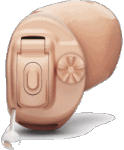
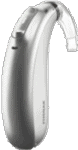
There are essentially two styles of external components: a simple “button” that is relatively thick; and a combination of behind the ear component linked by a wire to a relatively thin “button”.

Since I already wear a behind-the-ear hearing aid and have no difficulty in using it with my eyeglasses. I did not think at the time of the use of surgical masks. It turns out that the mask is always getting tangled in the device, but that’s no big deal.

On the other hand, some feel that the positioning of the microphones in the device near the external ear would be slightly better than the positioning on the thick button. That made sense, although I saw no objective evidence to support it. Finally, there was the question of compatibility with external devices, like telephones and computers, that was important to me.

Other criteria that could possibly have helped decide among the various models and brands, but they were not important to me.

When I finalized the order for the implant, the surgeon told me that a particular model was better suited to my particular pathology, with a build-up of calcium around the round window area of the cochlea. Since he wanted to use the same brand as the one I had already decided to use, everyone was happy.

Paying for it all

Happily, I live in a country where health insurance, although private, is mandatory for all residents. Disability insurance is mandatory for anyone with a revenue. The health insurance covers 90% of the surgeon’s and hospitalization costs. The disability insurance covers the cost of the cochlear implant, the audiologist and a certain number of speech therapy sessions. In short, it would all be affordable.

Getting rejected by an insurance company is an issue I see frequently in forums about hearing. I am glad to live where insurance companies treat their customers as basically honest, as opposed to that country where they seem to treat customers like crooks, where the default mode is to reject any claims.

There were a few snags to be worked out in my case, but all was done in a good spirit and expeditiously.

A little publicity

The hospital managed a video series highlighting various of its activities. It turns out that the department handling cochlear implants was to be featured just at the time I was to undergo the operation. So, I was asked if I were willing to participate in that video, with an interview before the operation; a filming of the operation itself; and filming the session when the implant was first activated.

Having benefited from my discussions with other patients, I was pleased to be able to contribute to the diffusion of information about cochlear implants. I agreed and the video is now available to the public.

The video is in French. For those faint of heart, you might wish to skip the part showing the operation itself, from 2:59–3:27.

The Operation

Running a hospital and scheduling the use of the operating rooms requires considerable agility. It’s fine and good to schedule an operation for a certain time, but emergencies do arise, causing changed scheduling of elective surgery. On top of that was all the uncertainty associated with handling the pandemic in 2020.

I was called the day before the scheduled operation telling me I was expected at 6:00 the next day. Concerned about the risks of surgery—however small they might be—I showered that evening using an antiseptic soap. I showered again the next morning with the same soap. And the few hours of sleep I had in between were on sheets freshly washed using an antibacterial product. Maybe I exaggerated, but the additional effort and cost were insignificant compared to the possible downside of an infection.

It turns out the operation did not start until 10:30.  You can see some of the details in the video above.

When I finally awoke it was early afternoon. By the time I returned to my room it was after the normal lunchtime, but I had the right to some chicken broth.

My wife was able to visit me in the afternoon—no small feat in a hospital hyper-conscious of the risk of COVID-19 infection. It just had to be organized in advance so she had a pass.

Unlike my previous experience in waking after an ear operation (recounted here), things went quite well. I had a minor headache. My throat was a little sore, presumably from the breathing tube put down my throat in conjunction with the general anæsthesia. It seems that some people suffer from some form of reflux under anæsthesia and this tube helps to reduce the risk of vomit clogging something. In any case, I had no such problem.

Finding a comfortable position to sleep that night was a little tricky. I slept on and off but did not have any major problems.

The next day, I was scheduled for a scan to make sure all was well, followed by my discharge. I use the word “scheduled” loosely, as I was ready for the scan at 8:00, but they did not get around to doing it until 15:30. The surgeon checked the results and I was on my way home by 16:30.

It would be several weeks before the implant would be activated, during which my major job was simply to heal.
You’re still young!

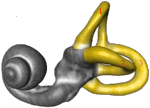
semi-circular canals and cochlea

My level of comprehension had been decreasing noticeably for at least a year. I was completely deaf in my right ear and wholly dependent on my top-of-the-line hearing aid in my left ear. I was 67 years old. I expected to live at least another decade, if not more. But what would happen if my hearing continued to get worse and worse? I could not expect that hearing aid technology would provide a solution.

After exposing this issue to my audiologist, he said, “You’re still young.” I thought, “I’m not so young as that.” But he meant that I was still in good health, strong and young enough to undergo surgery and recover with little difficulty. What surgery? He meant the surgery required for a cochlear implant.

In the past, my doctors had recommended against this sort of solution to my hearing problem. The latest opinion offered was that the quality of hearing via a cochlear implant is not equivalent to the quality offered by a hearing aid.

In the past, I had received such opinions with the thought, “OK, well maybe something else will come up.” But now, my thought changed to “What have I got to lose?” In the past, the memory of my experience following my failed stapedectomy was a vivid reminder of what was at risk. But now, I started to feel that this strong emotional response should be leavened by some objective knowledge.

Until now, all the opinions I had received were from professionals who did not perform cochlear implants. It was time to get the opinion of someone who performed them regularly and worked with patients having been implanted.

I presented my case to the otorhinolaryngologist who performs cochlear implants. On the one hand, my comprehension of speech had been decreasing to the point of making daily life difficult. I was afraid that this difficulty would only get worse. On the other hand, I was concerned about the past issue where the stapedectomy knocked my balance for a loop. I did not want a repeat of that. In short, I had two criteria in my find for deciding whether to pursue a cochlear implant (or any other solution, for that matter):

  • Would the solution be likely to improve my comprehension of speech?
  • What would be the risk to my sense of balance and the possibility of vertigo?

Naturally, no opinion could be offered about the potential benefits to me of a cochlear implant until a detailed analysis of my current state was made. So, I underwent the standard battery of tests: scans, NMI, hearing tests, balance tests, and so forth. I was spun around in the dark; my ears were filled with hot and cold water; my abysmal comprehension of words out of context was confirmed.

After all the results were in, I consulted the surgeon once again. He opined that I could get significant improvement in my hearing from a cochlear implant. I understand that the surgery itself was only the first step in achieving those benefits. They would depend, too, on the device implanted, on the configuration of that device to meet my needs, and especially on the work I would do, potentially over the course of a year or more, to learn to understand the signals that a cochlear implant could transmit.

As for the the issue of loss of balance and vertigo, the surgeon felt that there was no significant risk of this happening. The tests showed that the semicircular canals in my right ear no longer contributed to my sense of balance.

The decision was up to me.

A Series of Hearing Aids

behind the ear hearing aid

I entered a period of several decades characterized by gradual loss of more hearing and punctual increase in the power of my hearing aids.

My earliest hearing aids were analogical devices, installed in the ear. They were replaced every six years or so, as dictated by my disability insurance.

It wasn’t long before my hearing degraded to the point that only the most powerful devices on the market would be helpful to me. During the same period, the devices became digital sound processors, with multiple microphones and various processing algorithms designed to enhance understanding in difficult contexts.

To make a long story short, the only help I ever received from these hearing aids was the amplification of sound. None of the other features—reduction of background noise, directionality of sound, the supposed benefits of compression and so forth—were ever of any use to me.

In a sense, it is miraculous that I was able to continue my professional activity as long as I have. For many years, I have worked as a consultant and a trainer. My whole livelihood depended on the oral, face-to-face interaction with my customers.

Well, in the final two years of the training courses I led, I started to have significant difficulty in understanding everything my students would say to me. It was embarrassing and frustrating.

I decided to take my training courses on line. No longer would they be live interactions. Instead, I bought a lot of equipment to record my lectures, which are available on demand to the students. Exercises, quizzes and tests required no hearing on my part. I only led live, online sessions once a week. My exposure to the problems of inadequate comprehension was very limited.

Today, real time sub-titling technology could possibly be exploited to enhance my professional interactions. But at the time, such technology was not available.

Loss of Hearing

I distinguish between the loss of hearing and the loss of comprehension (even if I sometimes confound the two). Until very recently, my hearing aids could always amplify human speech sufficiently for me to hear them. The problem has not been there. Instead, the problem has become one of understanding what I hear.

That being said, there were always sounds that I would not hear at all, whereas another person could readily hear them, soft though they be.

I remember one day, not long after I got a new and more powerful hearing aid, I was sitting at home when I started to hear some loud cracking sounds, percussive sounds that I could not identify. After some investigation, they turned out to be the sound of a shotgun being fired by a local farmer who was attempting to prevent the formation of hail. I live in a wine-producing region where a single hail storm can destroy a year’s crop. I knew that this was a relatively common practice during the summer season of storms, but I had never heard the sounds before.

Loss of Comprehension

That loss of hearing is much less important that the loss of comprehension. About two years, I started to realize that I could hardly understand completely anything most people would say to me. There were exceptions, of course. I never have difficulty comprehending my siblings’ speech.

But, when I am obliged to ask my wife to repeat virtually everything she says, the situation becomes barely tenable. As frustrating as it is for me, it must be terrible to not be understood and to have to constantly repeat what one says.

What is to be done?

From time to time, I would ask my otorhinolaryngologist if there were anything to be done to help me, in addition to the hearing aid. Aware that technology advances rapidly, I wanted to know about potential solutions.

The answer I always received was that the auditory nerve on my right side, where I had the failed stapedectomy, had not been stimulated for a long time. Due to this long desuetude, it was too late, in the doctor’s opinion, for any solution depending on that nerve to improve my comprehension.

As my dependency on and interaction with medical professionals has increased, I have gained in understanding about the dynamics of those interactions. Some patients seem to abdicate responsibility for their health. They might ask questions of a doctor, but do not seek to develop their understanding beyond the bottom-line opinion proffered by the doctor. Other patients think they know more than the doctors, but depend on them as gateways to care and to medicines. And yet other patients try to understand as much as they can, take responsibility for their own decisions, but realize they need help from professionals. They depend on the doctors’ knowledge.

Similarly, some doctors offer their opinions and do not expect to be questioned about them. Others are frank about what is known and what is not known, but fail to provide the key information needed to make decisions. Some are very sensitive to the emotions and needs of their patients. Others less so.

As they say, it takes all sorts to make a world. But problems arise when the parties do not understand themselves and when there is a mismatch between what the patient needs and what the doctor is able to offer. Of course, similar issues exist between any two people, no matter what roles they play.

In the end, it was an audiologist, not a doctor, who triggered my entry into the next phase of my hearing odyssey. It was my audiologist who encouraged and supported the idea of getting a cochlear implant.

The Stapedectomy

stapes prosthesis

In September I moved to the town with the university where I took up my post-doctoral fellowship. I had a light teaching load, in addition to time for my research.

Although I was supposed to replace one of the professors on leave, it seems that his office was not available. So other members of the department suffered my temporary presence in their offices until something more fixed could be found. It was interesting to share space with a professor of Chinese history and a professor of Yiddish literature, even though I was probably a nuisance to them.

At that school, there was a very long vacation at the end of the year. So I planned to return to my parent’s home, have a stapedectomy done, recover there, and finally return to the university with the hearing of a hound-dog.


The Surgery

The surgery was done in the same hospital in which I was born. Of course, I have no recollection of the surgery itself, as I rapidly fell unconscious on the gurney outside the operating theater.

I woke up sometime later in my hospital room feeling great. I came out of the narcosis, but the anesthetic had not yet worn off. My father took me on a tour of the hospital, pushing me in my wheelchair.

Upon returning to my hospital bed, I must have briefly fallen asleep. When I awoke, the hell of severe vertigo, many times worse than what I had previously experienced, had descended on me.

My parents were still there in the hospital. I insisted to them that I wanted to return home immediately. Somehow, I was released from the hospital and my father drove us home. The whole trip was torture.

The Recovery

I made it upstairs in my parents’ home and collapsed again on my bed. That bed was my home for the next month.

The slightest motion of my head provoked waves of vertigo. Sitting up in bed was so unpleasant that I avoided it. Standing up and walking seemed an impossibility, although the call of nature has its own priorities.

I could hardly take an independent step. However, getting to the toilet by leaning against the wall and advancing slowly was workable. In any case, my parents were spared the indignity of handling a bed-pan.

In retrospect, I wonder if I should have made a greater effort to move and to walk much sooner. I couldn’t imagine doing so at the time. My strategy was to avoid the vertigo rather than to get used to it.

It was at this time that I was introduced to the Nero Wolffe books, by Rex Stout. My aunt gave me several volumes to read. They turned out to be just the thing—they kept me occupied during the long horizontal hours and did not require much effort to read.  I don’t think I had ever read any detective stories before that. I can’t say that I became hooked, but I do enjoy a good one from time to time. Anyway, who couldn’t appreciate a fat, orchid-loving New Yorker?

Performing a stapedectomy results in a clot of blood in the auditory canal. Together with the bandaging to protect the incision, there is no immediate hearing in the ear that has undergone the procedure.

About five weeks after the surgery, I returned to the doctor. I remember crossing the street with my family, feeling like a spastic simpleton, completely unable to walk in a straight line. I imagined that I had to learn once again how to walk, just as infants must do.

After the doctor removed the bandage and cleaned up the ear, we could only conclude that the stapedectomy was a complete failure. I had no hearing at all in my right ear.  And what is more, I had spent a terrible month in bed.

Although I was able to get around, I still had many bouts of dizziness and had very poor balance. I never saw that doctor again. I never had a diagnosis of what had gone wrong.

I suppose I could have insisted on getting a better understanding of what had happened to me, and why, and what could be done about it. But it seems that there was nothing to be done. I had no interest at all in blaming anyone. I was only anxious to put that experience as far behind me as possible.

A Return to Work

By rights, I probably should have stayed at my parents’ home another month. But the university was starting up again. I had a course to teach. So, I got in my car and drove back, a five-hour drive under the best of conditions. Half-way there, all the roads were covered with a layer of frozen snow. I must have felt charmed, for I did almost nothing to slow down. At least, there was hardly anyone else on the roads. As I drove, just moving my head to look at one mirror, then another mirror, or to turn around when backing up, provoked dizziness. I don’t know how I ever arrived safely at my destination.

The months that followed were accompanied by a buzzing in my head, together with my problems of balance.  During the years that followed, I would very rarely have minor bouts of vertigo.

I entered a period of dependency on a single ear and the hearing aid place in it.

A First Hearing Aid

in the ear hearing aid

My youthful optimism might have been somewhat tarnished by my first encounter with significant auditory problems. But, I was still largely functional. I don’t remember that period as being one in which I was hard of hearing.

On the other hand, it was a period of transition for me. I was leaving graduate school, the friends, colleagues and teachers I had known for up to six years. I was to take up a post-doctoral fellowship the following year at another university.

During the six months following my graduation, I was fitted with a hearing aid in the left ear and I prepared for a stapedectomy in my right ear.

My father, who also had hearing difficulties, seems to have been finally pushed by my own experience to do something about his hearing problems. That summer, while waiting to move to my new university, I lived with my parents.

My father and I would go together to the doctor he found in the city, a doctor supposed to have been at the top of his field.

My father grew up in the city but had never visited the many touristy places in town—places of world renown. So, together we would go see the doctor, have lunch and visit many of these famous monuments. It was a period in my life where my relationship with my father was unlike any other period. I look back at the period with special fondness.

The day we were both fitted with our first hearing aids, we took the subway downtown. The tremendous roar of the train as it came into the station was completely unexpected. This was my first experience with that noisy world that sometimes causes people to reject the wearing of their hearing aid. The problem, of course, is that the hearing aid I wore (an analogical device, typical of the period), did not discriminate between amplifying the sounds I wanted to hear and the sounds that disrupt what I wanted to hear.

And so, I was disabused of the idea that my hearing was OK. It was not. I really needed the help that a hearing aid could bring.

In any case, I was optimistic about the upcoming stapedectomy which, according to the doctor, restores normal or near-normal hearing in over 90% of the cases. Really good odds, no?