Personal thoughts and history
Health care for students at large, urban universities is almost a joy. Top doctors using state of the art equipment provide rapid service at no cost to the students.
The diagnosis of my condition was interesting because it combined very simple diagnostic techniques with techniques requiring numerous sondes and mysterious machines.
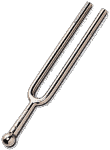
Tap on a tuning fork. Place the fork near the ear. Then press the base of the fork against the skull behind the ear. Do you hear a difference in volume? If so, you obviously have some dysfunction in the outer or the middle ear. If not, the problem is farther downstream, in the inner ear, the auditory nerve or the brain.
What about my problem of occasional, intense vertigo? There could be many causes. Techniques like electronystagmography help inform the diagnosis.
And, of course, the traditional hearing tests, checking the hearing of beeps at different frequencies and volumes and checking one’s comprehension of phonemes and words, all play a part in the diagnosis.
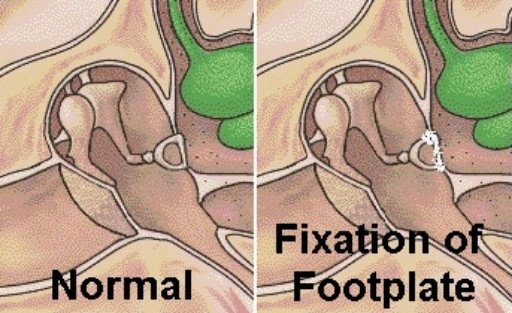
The result was a diagnosis of otosclerosis in both ears with a probable issue with the inner ear in the right ear. Otosclerosis is a stiffening of the stapes in the middle ear due to a bony deposit
The remedies? The classic remedy was the stapedectomy. Otherwise, a hearing aid could be used. No specific diagnosis of the vertigo problem was made, other than to say that it could be a result of the otosclerosis. It was not, for example, a symptom of Ménière’s disease or a brain tumor. Thank heaven for such small mercies.
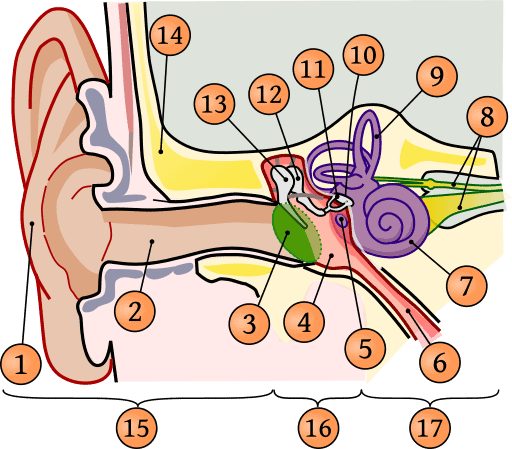
1—Auricle
2—Outer ear
3—Tympanic membrane
4—Tympanic cavity
5—Round window
6—Eustachian tube
7—Cochlea
8—Cochlear nerve/ Vestibular nerve
9—Semicircular canals
10—Round window
11—Stapes
12—Incus
13—Malleus
14—Skull
15—Outer ear
16—Middle ear
17—Inner ear
A stapedectomy is the replacement of the third bone in the middle ear, the stapes (#11), by a prosthesis. The prosthesis is anchored in the inner ear, around the round window (#10) and hooked onto the second bone of the middle ear, the incus (#12). The prosthesis thus transmits the vibrations of sound, which the stapes was failing to do adequately, to the inner ear.
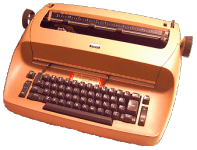
I was finishing up my graduate studies. My dissertation was 98% typed up; I had returned the rented electronic typewriter. (Yes, this was in the days before electronic word processing.)
The department’s secretary kindly allowed me to use a typewriter in her office to finish the typing. As I was typing the last pages, I suddenly felt flushed and increasingly subject to vertigo.
Except for one particularly drunken evening at college, I had never felt my head turn such as it was spinning around. I somehow managed to collect my manuscript and walk home.
The 18 block walk was hellish. I could barely walk straight. How I must have appeared to anyone I passed on the street! I think I vomited twice. I finally arrived home and collapsed on my bed.
The next day I felt completely restored, excepting the disquiet associated with this mysterious attack. Was it food poisoning? Had I contracted some bug? Remember, at this time the Internet was in its infancy and there was no World Wide Web. The plethora of websites advising you on health issues simply did not exist.
As the Germans say, einmal ist keinmal. But this was not to be. Over the next few weeks, I had repeat episodes of that intense vertigo that kept me pinned to my bed. Happily, as I learned in retrospect, these episodes never lasted more than a few hours. But those hours were scary enough. I had no idea what was happening to me. I had no similar experience in my life. I know no one with the same symptoms.
My appointment with the otorhinolaryngologist was fixed.

One of my very early memories concerns having to visit the doctor because I had put little pebbles in my ear. The doctor sucked them out with a vacuum device. There was no impact on my hearing. I don’t remember the year in which that occurred, but it was probably before I entered nursery school or kindergarten.
Otherwise, I never had any difficulties with hearing before I entered university. My level of hearing was always good enough that it was never in question through university, too.
That being said, I recall two occasions where one of my ears was blocked with wax. A visit to the doctor resolved that issue. I remember the drops that supposedly dissolved the wax and the device that sprayed warm water into my ear to clear out the dissolved wax.
My early years at graduate school, too, were not marked by any hearing difficulties. In fact, from about 3rd grade until my first year at graduate school I was an active musician.
No, I was not a rock musician playing at 90 decibels or more. I was mostly playing classical music—playing the clarinet for the first three years and then switching to the oboe and, on occasion, the English horn. I also played alto sax in the marching band.
Playing this music, especially the music I played in orchestras, was particularly fulfilling for me. Although never playing at a professional level, my oboe teacher did tell me that I could enter a conservatory. As it turned out, I happily never made such a decision.
In retrospect, my level of hearing must have started to slowly deteriorate during graduate school. I never had a hearing test, so there are no objective measures to support this assumption. But I think I tended to play the radio or records louder than my neighbors expected. That being the case, I don’t recall ever having difficulty hearing or understanding what my friends, colleagues and teachers were saying.
All that was to end just as I was finishing my graduate studies.
I don’t pretend having important insights into human hearing. I have certainly not done any scientific or sociological research in the area. I have no more medical knowledge than any alert and inquisitive patient. So, why bother publishing anything about the subject?
I am writing in part for me, in part for others with an interest in hearing. Writing down what I have experienced helps me to formulate and to understand that experience. But that understanding and my memory of my experience will certainly evolve. Thus, I reserve the right to return to these pages and change anything at all.
I do maintain a log of the results of my hearing exercises. This log is of inestimable value in helping me focus on my greatest hearing problems. But such a log does not record my emotional states and my beliefs about myself and my experience.
Furthermore, many people facing hearing issues are faced today with choices that were inimaginable only a few decades ago. Not only are sophisticated external devices available to help hearing and comprehension. Various forms of surgery are able to restore hearing in many people who otherwise would be as deaf as a dollar bill.
I hope to share with these people some personal information that may be of use to them. I hope to return to the community something the community has shared with me and many others with great alacrity.
These pages are not a diary, although there is a chronological sense to the articles. Maybe I am not sufficiently attuned to my inner workings to see enough to recount my hearing on a daily basis. Hearing changes, but tends to change very slowly, except when punctuated by accidents, diseases and other mishaps. Thus, my sense of time is more like the chronology of an 18th century novel.
I owe my decision to write these pages to two other external influences. I have just finished reading Siri Hustvedt’s book Memories of the Future, a sort of epistemology of the self, of memory, of writing and of fiction. And a neighbor of mine, a neurologist having worked with children and adults with hearing issues, asked me if I keep a journal. This site is, in part, an answer to his question.
As our use of automobiles and mobility in general evolves, automobile insurance shall have to evolve, too. Most insurance policies today protect drivers and owners against three types of risk:
As we increasingly think of automobiles as resources that enable mobility, rather than financial assets, insurance policies will need to keep in step with this change. In particular, we shall need to insure against the risk of lost mobility.
Let’s take an example of insurance that works as intended. Party A purchases a new automobile. Party B causes an accident which damages the automobile of party A. Party B’s liability insurance will cover the cost of repairing party A’s automobile.
In another example, party A drive’s its automobile into a fire hydrant and damages both it and the automobile. Party A’s liability insurance covers the cost of repairing the fire hydrant and the collision insurance covers the cost of repairing the automobile.
Now let’s take another example. Party C has a 15 year old automobile. It runs great. That car is used to travel to and from work, as well as for innumerable other trips of all sorts. Party A causes an accident with Party C. However, in this case, Party A’s insurance company says, “The cost of repairing party C’s automobile far exceeds it’s market value. We will pay only up to the market value of the vehicle.”
In this case, party C might recover the financial value of the automobile, but has lost mobility. As it is impossible to find an equivalent automobile with the money paid by party A’s insurance, party C suffers a significance loss of mobility and the related strains and losses. Junior no longer has transportation to athletic matches. However is party C to do the week’s grocery shopping? Trips to the doctor become nightmarish.
Can we imagine insurance that covers the risk of lost mobility, complementing the loss of an automobile’s market value? When an automobile is newish and its market value exceeds the cost of repairs, the traditional insurances provide coverage. But as the market value becomes lower and lower, we inevitably reach the point where the mobility insurance would come into play.
Typically, automobile owners buy collision insurance for newish cars, but let it lapse after a few years. Instead, they could maintain that coverage indefinitely, with the coverage changing from protection of financial asset value to coverage of the costs of mobility.
How do we calculate the cost of mobility? Clearly, the calculation depends on the degree to which the insured lives in a region covered by a public transportation network. When there is no such network, then mobility depends on taxis or ride-sharing services. When even these services are lacking mobility depends on finding replacement vehicles.
An argument might be made that automobile insurance is not intended to replace prudent financial management of one’s assets. In particular, any asset is supposed to have an operational life, during which time provisions should be accumulated toward the ultimate replacement of that asset. Thus, suppose you buy an automobile for 40’000, expecting to use it for 10 years. In addition to all the operational costs , you should set aside 4’000 per year (or more) so that in ten year’s time you will have the funds needed to replace the automobile.
Of course, most people do precisely the opposite. Rather than saving up money to buy something in the future, they borrow money at purchase time and end up paying much more, due to the interest charges.
Be that as it may, collision insurance is conceived today as protecting you against the risk of needing to replace the automobile before you have saved enough money to replace it.