
Choosing a Surgeon

As I am now facing imminent corrective surgery for my cochlear implant, my thoughts have lingered on the question of how well does a given surgeon practice surgery. These thoughts center around three topics:

  • Surgery as a complex system
  • Biases in reports on surgeon “quality”
  • Regression to the mean

Surgery is a complex system

It is pretty obvious that anyone undergoing surgery is participating in a complex system, rather than being solely dependent on a particular surgeon’s skills. All of the actors in the system contribute to the quality of the outcome. Does the anesthesiologist select the most appropriate methods? Is the anesthetic under careful enough control? What percentage of the  surgical assistant’s actions are sufficiently timely and accurate? How clean is the operating theater? How well rested is the patient? Has the patient taken care to be hygienic and prepare for the surgery with appropriate vaccinations? And yes, has the surgeon selected the most appropriate method? Does the surgeon execute that method accurately enough? Is even the “best” method any good at all?

And those questions just takes into consideration the more immediate issues. Does the surgeon have family members whose cares dominate the surgeon’s thoughts? Have the patient’s acquaintances created an atmosphere of negativity around the patient? And so forth….

As with any complex system, many of these factors influence other factors, It is impossible to isolate single causes of an outcome. Nor is it likely that factors can be correlated with outcomes in a simple, linear fashion. Instead, there are probably tipping points in those correlations. Up until a certain point, the combination of factors may seem anodyne. It takes but a slight change in one factor to trigger a cavalcade of mishaps.

As a complex system dependent on so many factors or such variable and often unclear dependencies, we can hardly speak of surgery as causing successful or unsuccessful outcomes. Instead, we must speak of the probabilities of outcomes.

My first surgery was a stapedectomy. At the time, the surgeon told me that 95% of cases showed improvement; 4.5% of the cases resulted in no significant change in hearing; and the remaining .5% resulted in a worse condition.  Those statistics sound great for a population as a whole. But what do they mean for individuals? Since I belonged to that .5%, I can tell you that the statistics help to convince yourself that you did not make a stupid decision in going ahead with the surgery. Anyway, it’s best to focus on the next steps to make the best of a situation and try to improve, rather than to focus on past decisions that led to unfortunate outcomes.

Biases about surgeons

We all know that surgeons are surrounded by a mystique. That mystique is fed and reinforced from many directions. One of the most important effects of this mystique is the creation of biases in the minds of patients.

One of the most important biases is the classification of surgeons into two categories: butchers and miracle workers. We are inevitably led to such thoughts because we seek to make decisions about which surgeon to use. Those decisions are all 100% or 0% type decisions. Either you use a given surgeon or not. You normally cannot use one surgeon for75% of the surgery and another surgeon for the remaining 25%, as a sort of bet-hedging. In short, we seek simple answers to complex questions.

In our attempt to find the “right” surgeon, we ask around for opinions and recommendations. If a friend or family member tells us of a “miracle worker”, we are, of course, very favorably biased in favor of that surgeon. But, in all likelihood, we have merely replaced our own biases by someone else’s. Was that assessment as “miracle worker” based on a single case, or was it an assessment based on 20 years of experience performing hundreds of operations? It is almost certainly the former, since statistics for the latter hardly ever exist.

And what happens if we undergo surgery by a miracle worker where is outcome is not positive. The surgeon’s mystique is likely to lead us to the conclusion that the fault is in ourselves, or in our stars, but hardly due to the surgeon.

Another important bias is the unwillingness to bad-mouth someone. If the outcome was not favorable, many people hesitate to put the blame on the a single cause—we are too nice or circumspect to do so; we are happy to extend the benefit of a doubt (and rightly so).

Regression to the mean of surgical performance

Daniel Kahnemann and Amos Tversky (among many others) have written about the problem of not recognizing the impact of regression to the mean. They recount the story of the how the air force trainer would severely berate pilots who performed poorly on a flight. In their next flights, those pilots inevitably performed much better, so the trainer was convinced the the tongue-lashing was very effective as a technique. In reality, however, the trainer’s methods have little to do with the performance on individual flights. In any case, the next flight was almost certain to be better. This is the phenomenon of the regression to the mean.

Thinking about surgery in these terms can be instructive. Let’s imagine a hospital where the outcomes of a certain type of surgery are grouped as follows:

  • In 75% of the cases, the outcomes are pretty good
  • In 15% of the cases, the outcomes are really excellent
  • In 8% of the case, the outcomes are not so good
  • And in the remaining 2% of the cases, the outcomes are quite bad

Suppose your friend tells you that he heard of a recent case where Dr. X performed wonders. In other words, that case was one of the 15% of the cases with an excellent outcome. What is the likelihood that Dr. X’s next surgery will also be excellent? It is only 15% of the time. In other words, the next case, in 85% of the times, will have a poorer outcome!

Now, let’s suppose that friend heard about the case where Dr. Y’s effort resulted in a very poor outcome. That is one of the 2% of the total cases. So, there is a 98% probabilitiy that Dr. Y’s next case will have a better result.

My choice of a surgeon

I underwent cochlear implant surgery about 2 years ago. The result was a significant improvement of my comprehension of human speech, but the result was far from the potential of cochlear implants.

It turns out the electrode was not positioned optimally. It got stuck on a calcium deposit and so was not married to the cochlea as well as it might, at the place. The result is a sound dominated by sibilance.

I suppose some people might blame the surgeon for this mishap. But I find this largely irrlevant to my choice of a surgeon. As far as I am concerned, that surgeon is the only person to have examined my cochlea up close, and that has to be an advantage.

In any case, with some luck the surgical system will regress to the mean and I will end up with an improvement. I’ll let you know how things turn out.

Like Learning a Language

crossword

Most of us probably cannot remember when we were one or two years old, first learning to speak. In my mind, learning to hear and comprehend via a cochlear implant resembles learning a new language.

Do you remember your first lessons in learning another language, when you listened to a conversation in that language? If you are like most of us, You couldn’t make heads or tails of the speech. It sounded like gibberish.

However, as you learned some basic principles of that language, as you performed exercises and, especially, as you tried speaking and listening, you gradually gained in comprehension and your facility in using that language.

So it seems to be when you first have a cochlear implant installed. Unless you are one of those miracles who understand everything right away, a cochlear implant allows you to hear sounds, but you comprehend few of those sounds.

What you first hear

If you were adequately prepared for the experience of getting a cochlear implant, you had been told to expect voices to sound “robotic” or “electronic”. That’s not at all how I would describe my own experience.

At first, I was at a loss to describe what I was hearing. But I quickly found a vocabulary to express what I was hearing. Sounds were whooshing. It was as if speech were windswept. In many ways, voices sounded as if people were whispering, albeit those whispers were at a normal loudness and not at all soft.

On top of that was a whole series of sharper sounds punctuating my hearing. It took me even longer to find a way to express these sounds. Imagine that the person talking to you is also balling up a piece of aluminum foil. I was hearing that crinkly, metallic sound of touching the foil.

For a while, I was convinced that the metallic sounds were due to some defect in the device or some problem of configuration. How could I possibly be hearing all these noises while sitting in a perfectly calm office? I was disabused of this idea through a simple test. The audiologist led me to one of those highly insulated rooms in which hearing tests are made. And lo, all those metallic sounds stopped.

I couldn’t believe how noisy the world had become during the previous decades of diminished hearing.

Two ears, but how many sounds?

I was long accustomed to hearing with only one ear. But now I had two ears hearing things. If someone would say a word to me, I would hear two entirely different sounds. I was not yet capable of fusing the inputs from my left and right ears into one sound.

When the audiologist would ask me where I heard things, my answer was that the sounds from my left ear appeared to be localized in the center of my head, whereas the sounds from my right ear were localized in the right ear.

For the first few months, the differences in sounds between the two ears and my inability to hear and understand them as a single sound, led me to consider the sounds from the cochlear implant were distracting me from comprehending speech.

This belief was perhaps hindering my rehabilitation. After a few months, a speech therapist demonstrated to me, via some simple tests, that I comprehended better when I used both ears than when I used my left, hearing aid ear, alone. Since then, I’ve tried to put a more positive outlook on the strangeness of what I hear. Keeping a positive attitude and having that attitude reinforced by others is very important to my hearing rehabilitation.

Exercises

I live together with my wife in a house somewhat apart from the neighbors. I don’t have an office where I meet colleagues. And my social activities have been strictly limited due to the confinement and social distancing we practice to limit the effects of the COVID-19 pandemic.

So, I cannot depend very much on chattering away with different people all day long as a way of accelerating my hearing rehabilitation. Doing exercises has become all-important.

Hearing exercises are unlike academic exercises

The other great frustration with hearing exercises is reaching a blockage where there is simply nothing you can do to improve. For example, a common type of exercise hinges on understanding the difference between two consonants or vowels. In my current state, I am utterly incapable of distinguishing an “m” from an “n”, and distinguishing a “d” from a “g” is really hard. No matter how many times I redo exercises, my success rate with “m” and “n” seems to be random. There is nothing I can hook onto, no trick that allows me to master the skill. You can imagine it is not easy if one cannot distinguish between “ma’am” and “man”.

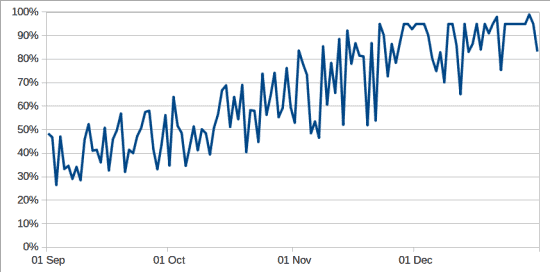
exercise success rates
The ups and downs in performing hearing exercises resemble the changes in stock prices. Trends are visible only over the long term.

I find the hearing exercises to be very different from the academic exercises I used to do, like learning the multiplication tables or the declensions of Latin nouns. For those exercises, you could reach a point where the knowledge was acquired and there was no going backward. With my hearing exercises, I could get a 90% correct rate for an exercise, but two weeks later get only 50% correct two weeks later. So, understanding what you hear is not a cognitive skill like knowing the rules of algebra. Perhaps a better analogy would be with stock market prices that fluctuate widely from hour-to-hour and day-to-day. It is only after a year can you see a definite trend.

Challenging exercises

Currently, my favorite exercises involve trying to comprehend complete sentences or short conversations. In my current state, the first time I listen to a recording I am lucky to understand one or two words. I replay the phrase, listening for the sounds that do make sense to me. I play it again, trying to imagine what word could possibly fit the pattern of sounds I think I hear. Once I convince myself I have understood a word, figuring out the neighboring words becomes much easier.

Play Video

A simulation of repeating an exercise and increasing comprehension with each repetition.

In this sense, the exercise resembles a crossword puzzle. Some clues are easy. Those answers fill in letters for the terms that are more ambiguous. You make a few guesses and you start to see a pattern to the whole. Often, there is a very difficult section with one or two clues that you simply cannot solve. Similarly, after playing a sentence five, ten or even fifteen times, I can usually figure out what is being said. But sometimes there is a word whose sense I simply cannot detect. If I were in a real conversation with someone, I would simply ask for clarification. But in my exercises, my solution of last resort is to turn on my hearing aid and listen to the sentence with both ears. Once you know what is being said, everything becomes crystal clear. You hear everything where, just a minute ago, it was all nonsense.

This sort of exercise is fulfilling because you have a clear way of seeing the progress you make. Furthermore, there is almost always a little bit that is still not clear, showing you that you still have more work to do, something else to learn and to improve.

More basic does not mean easier

Paradoxically, the simplest exercises are sometimes the most frustrating. One exercise consists of listening to three tones, as if someone had played three notes on a piano. The idea is to identify which tone is different from the other two.

As someone who has played a variety of musical instruments, especially between the ages of eight and twenty-five, the inability to distinguish two different notes is extremely frustrating. Worse is that I can do nothing about this inability. This is similar to the problem of confusing “m” and “n” to which I referred above.

On the one hand, I have been told that my inability is due to the limits of cochlear implant technology. Imagine, for example, that you had to represent the 88 different notes on a piano with a palette of only 22 detectable notes. Thus, do, di, re and ri all sound the same. On the other hand, you can hear the difference between do and mi. Imagine hearing the lyrics, “Do, a deer, a female deer” sung in a monotone.

I don’t know what to make of people with cochlear implants who say they fully appreciate music. Setting aside the philosophical question of how to compare perceptions by two different people of the same sense data, I sometimes have the uncharitable thought that these people are simply tone-deaf. I know that I am, at least in my right ear.

There is another exercise in which you are supposed to identify which musical instrument is playing a snatch of a tune. I am a whiz at identifying the snare drum and even the xylophone. I am not too bad at identifying the breathiness of the flute. But, for someone who used to be able to easily distinguish a viola from a violin, it is extremely hard on my self-esteem to fail to hear the difference between a clarinet and a ‘cello. And worst of all, none of these recordings (aside from the snare drum) sound at all like the  instruments supposedly being played. Will this utter lack of appreciation evolve? I dearly hope so.

Starting Rehabilitation

Home from the hospital with a device implanted in my head and a bandage covering my right ear. As with any wound or incision, the advice was to keep it dry.

I was expecting to have to keep it dry for about four weeks—but more about that in a minute. Four weeks without washing my hair. In any case, we were living through a period of confinement to our homes, excepting trips to stores for absolutely necessary commodities.

I tend to toss and turn while sleeping, so there was no way the clumsy bandage—more of a turban than the elegant cups covering the ear that I see in some photos—would stay in place. No particular difficulties, though.

The light headache I experienced the first day continued for a day or two. It was easily handled by an over-the-counter analgesic.

Finishing the cochlear implant video

I had agreed to participate in a video prepared by the hospital about cochlear implants (see here). The first two parts of my participation—my thoughts in advance of the implant and the surgery itself—were already filmed. The third part—the activation of the implant—remained to be done.

The publication date for the video was already fixed. To meet that date, my device activation would have to be done only two weeks after the surgery, not the more typical four weeks. So long as the surgeon agreed, I had no reason to delay activation.

Hearing is Believing

I had been well prepared regarding what to expect when the implant was activated. I had read about people hearing sounds qualified as “robotic” or “electronic”, whatever that really means.

What the implant was first turned on, I did not indeed hear sounds. These sounds confirmed that the basic mechanism was working, that my cochlea, auditory nerve and brain were still capable of hearing. It was a great leap for my morale. While my otorhinolaryngologist had opined that a cochlear implant would most likely help me, hearing is believing.

The first activation session is not so much about hearing as about the care and feeding of a cochlear implant. The audiologist needed to be sure that I could handle the device correctly: how to turn it on and off; how to replace batteries; how to charge my chargeable batteries; how to put the device on my ear and position the antenna correctly. We went through the contents of the whole device system, including the drying device, the charging device, the connection to the smartphone and how the smartphone app could control the implant.

No Small Miracles

Coincidentally, the French television had just published a video about cochlear implants, featuring the implant activation for an older man. It appears in the video that he was able to understand and converse immediately following device activation.

It appears that a few people have this ability. The cochlear implant, such as it is configured out of the box, just works. For such people, the device is like a hearing aid. You turn it on and you can hear! Well, for most people, turning on the cochlear implant is merely one step in a long process of device adjustment, listening, talking and doing exercises.

When it came to the stapedectomy, I was in that very small class of people for whom the operation made my hearing worse. But when it came to the cochlear implant, I joined the vast majority for whom comprehension would be the result of a long period of rehabilitation. No small miracles for Robert there.

Starting the Rehabilitation

The most important advice of the audiologist was simply to wear the implant and to listen to people talking. Wearing the device might seem self-evident, but I suppose many people find reasons not to do so.

One set of reasons concerns what people hear. Since they do not understand these sounds and since they did not have reasonable expectations regarding the need for rehabilitation, they might be deeply disturbed by the noises they hear. And believe me, you hear all sorts of things you had completely forgotten could make sounds (assuming you had been able to hear something before the implant). And those sounds can indeed be noisy and disturbing.

A second issue concerns the environment in which one lives. I live in a house with my wife. I have worked independently for many years, so I had no office to which I would repair on a daily basis. In fact, my professional activities had been tailing off and I was not dealing with clients on a daily basis. Finally, since was have been living in an era of social distancing, most people have been hesitant to interact on a face-to-face basis. In my case, all these factors resulted in an extremely quiet environment, with only a few hours of hearing human voices each day.

The third issue with wearing the processor of a cochlear implant is that it might be physically uncomfortable. I was accustomed to a hearing aid, so the component behind my ear was not novel. In fact, lacking the tube going into the auditory canal, I was surprised how well the device stayed in place. The other issue is the external antenna. Since it is held in place by magnets, it might be necessary to adjust the strength of the magnet. Too strong and it might irritate the skin or just hurt. Too weak and the device might easily fall off. As it happens, I have not had any issue with the magnets.

Speech Therapy

The hospital has a speech therapist on staff. My insurance entitled me to a series of sessions with her. However, she was fully booked, so I had to wait a few months before a slot opened for me. A will return to my experience with the speech therapist in a later posting.

The Start of Exercises

The early phase of rehabilitation combines sessions with the audiologist to tune the cochlear implant to the patient’s particular needs with the exercises done by the wearer of the implant. I will describe those exercises in my next installment.