A Series of Hearing Aids

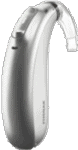
behind the ear hearing aid

I entered a period of several decades characterized by gradual loss of more hearing and punctual increase in the power of my hearing aids.

My earliest hearing aids were analogical devices, installed in the ear. They were replaced every six years or so, as dictated by my disability insurance.

It wasn’t long before my hearing degraded to the point that only the most powerful devices on the market would be helpful to me. During the same period, the devices became digital sound processors, with multiple microphones and various processing algorithms designed to enhance understanding in difficult contexts.

To make a long story short, the only help I ever received from these hearing aids was the amplification of sound. None of the other features—reduction of background noise, directionality of sound, the supposed benefits of compression and so forth—were ever of any use to me.

In a sense, it is miraculous that I was able to continue my professional activity as long as I have. For many years, I have worked as a consultant and a trainer. My whole livelihood depended on the oral, face-to-face interaction with my customers.

Well, in the final two years of the training courses I led, I started to have significant difficulty in understanding everything my students would say to me. It was embarrassing and frustrating.

I decided to take my training courses on line. No longer would they be live interactions. Instead, I bought a lot of equipment to record my lectures, which are available on demand to the students. Exercises, quizzes and tests required no hearing on my part. I only led live, online sessions once a week. My exposure to the problems of inadequate comprehension was very limited.

Today, real time sub-titling technology could possibly be exploited to enhance my professional interactions. But at the time, such technology was not available.

Loss of Hearing

I distinguish between the loss of hearing and the loss of comprehension (even if I sometimes confound the two). Until very recently, my hearing aids could always amplify human speech sufficiently for me to hear them. The problem has not been there. Instead, the problem has become one of understanding what I hear.

That being said, there were always sounds that I would not hear at all, whereas another person could readily hear them, soft though they be.

I remember one day, not long after I got a new and more powerful hearing aid, I was sitting at home when I started to hear some loud cracking sounds, percussive sounds that I could not identify. After some investigation, they turned out to be the sound of a shotgun being fired by a local farmer who was attempting to prevent the formation of hail. I live in a wine-producing region where a single hail storm can destroy a year’s crop. I knew that this was a relatively common practice during the summer season of storms, but I had never heard the sounds before.

Loss of Comprehension

That loss of hearing is much less important that the loss of comprehension. About two years, I started to realize that I could hardly understand completely anything most people would say to me. There were exceptions, of course. I never have difficulty comprehending my siblings’ speech.

But, when I am obliged to ask my wife to repeat virtually everything she says, the situation becomes barely tenable. As frustrating as it is for me, it must be terrible to not be understood and to have to constantly repeat what one says.

What is to be done?

From time to time, I would ask my otorhinolaryngologist if there were anything to be done to help me, in addition to the hearing aid. Aware that technology advances rapidly, I wanted to know about potential solutions.

The answer I always received was that the auditory nerve on my right side, where I had the failed stapedectomy, had not been stimulated for a long time. Due to this long desuetude, it was too late, in the doctor’s opinion, for any solution depending on that nerve to improve my comprehension.

As my dependency on and interaction with medical professionals has increased, I have gained in understanding about the dynamics of those interactions. Some patients seem to abdicate responsibility for their health. They might ask questions of a doctor, but do not seek to develop their understanding beyond the bottom-line opinion proffered by the doctor. Other patients think they know more than the doctors, but depend on them as gateways to care and to medicines. And yet other patients try to understand as much as they can, take responsibility for their own decisions, but realize they need help from professionals. They depend on the doctors’ knowledge.

Similarly, some doctors offer their opinions and do not expect to be questioned about them. Others are frank about what is known and what is not known, but fail to provide the key information needed to make decisions. Some are very sensitive to the emotions and needs of their patients. Others less so.

As they say, it takes all sorts to make a world. But problems arise when the parties do not understand themselves and when there is a mismatch between what the patient needs and what the doctor is able to offer. Of course, similar issues exist between any two people, no matter what roles they play.

In the end, it was an audiologist, not a doctor, who triggered my entry into the next phase of my hearing odyssey. It was my audiologist who encouraged and supported the idea of getting a cochlear implant.

The Stapedectomy

stapes prosthesis

In September I moved to the town with the university where I took up my post-doctoral fellowship. I had a light teaching load, in addition to time for my research.

Although I was supposed to replace one of the professors on leave, it seems that his office was not available. So other members of the department suffered my temporary presence in their offices until something more fixed could be found. It was interesting to share space with a professor of Chinese history and a professor of Yiddish literature, even though I was probably a nuisance to them.

At that school, there was a very long vacation at the end of the year. So I planned to return to my parent’s home, have a stapedectomy done, recover there, and finally return to the university with the hearing of a hound-dog.


The Surgery

The surgery was done in the same hospital in which I was born. Of course, I have no recollection of the surgery itself, as I rapidly fell unconscious on the gurney outside the operating theater.

I woke up sometime later in my hospital room feeling great. I came out of the narcosis, but the anesthetic had not yet worn off. My father took me on a tour of the hospital, pushing me in my wheelchair.

Upon returning to my hospital bed, I must have briefly fallen asleep. When I awoke, the hell of severe vertigo, many times worse than what I had previously experienced, had descended on me.

My parents were still there in the hospital. I insisted to them that I wanted to return home immediately. Somehow, I was released from the hospital and my father drove us home. The whole trip was torture.

The Recovery

I made it upstairs in my parents’ home and collapsed again on my bed. That bed was my home for the next month.

The slightest motion of my head provoked waves of vertigo. Sitting up in bed was so unpleasant that I avoided it. Standing up and walking seemed an impossibility, although the call of nature has its own priorities.

I could hardly take an independent step. However, getting to the toilet by leaning against the wall and advancing slowly was workable. In any case, my parents were spared the indignity of handling a bed-pan.

In retrospect, I wonder if I should have made a greater effort to move and to walk much sooner. I couldn’t imagine doing so at the time. My strategy was to avoid the vertigo rather than to get used to it.

It was at this time that I was introduced to the Nero Wolffe books, by Rex Stout. My aunt gave me several volumes to read. They turned out to be just the thing—they kept me occupied during the long horizontal hours and did not require much effort to read.  I don’t think I had ever read any detective stories before that. I can’t say that I became hooked, but I do enjoy a good one from time to time. Anyway, who couldn’t appreciate a fat, orchid-loving New Yorker?

Performing a stapedectomy results in a clot of blood in the auditory canal. Together with the bandaging to protect the incision, there is no immediate hearing in the ear that has undergone the procedure.

About five weeks after the surgery, I returned to the doctor. I remember crossing the street with my family, feeling like a spastic simpleton, completely unable to walk in a straight line. I imagined that I had to learn once again how to walk, just as infants must do.

After the doctor removed the bandage and cleaned up the ear, we could only conclude that the stapedectomy was a complete failure. I had no hearing at all in my right ear.  And what is more, I had spent a terrible month in bed.

Although I was able to get around, I still had many bouts of dizziness and had very poor balance. I never saw that doctor again. I never had a diagnosis of what had gone wrong.

I suppose I could have insisted on getting a better understanding of what had happened to me, and why, and what could be done about it. But it seems that there was nothing to be done. I had no interest at all in blaming anyone. I was only anxious to put that experience as far behind me as possible.

A Return to Work

By rights, I probably should have stayed at my parents’ home another month. But the university was starting up again. I had a course to teach. So, I got in my car and drove back, a five-hour drive under the best of conditions. Half-way there, all the roads were covered with a layer of frozen snow. I must have felt charmed, for I did almost nothing to slow down. At least, there was hardly anyone else on the roads. As I drove, just moving my head to look at one mirror, then another mirror, or to turn around when backing up, provoked dizziness. I don’t know how I ever arrived safely at my destination.

The months that followed were accompanied by a buzzing in my head, together with my problems of balance.  During the years that followed, I would very rarely have minor bouts of vertigo.

I entered a period of dependency on a single ear and the hearing aid place in it.

A First Hearing Aid

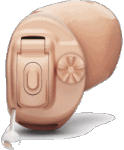
in the ear hearing aid

My youthful optimism might have been somewhat tarnished by my first encounter with significant auditory problems. But, I was still largely functional. I don’t remember that period as being one in which I was hard of hearing.

On the other hand, it was a period of transition for me. I was leaving graduate school, the friends, colleagues and teachers I had known for up to six years. I was to take up a post-doctoral fellowship the following year at another university.

During the six months following my graduation, I was fitted with a hearing aid in the left ear and I prepared for a stapedectomy in my right ear.

My father, who also had hearing difficulties, seems to have been finally pushed by my own experience to do something about his hearing problems. That summer, while waiting to move to my new university, I lived with my parents.

My father and I would go together to the doctor he found in the city, a doctor supposed to have been at the top of his field.

My father grew up in the city but had never visited the many touristy places in town—places of world renown. So, together we would go see the doctor, have lunch and visit many of these famous monuments. It was a period in my life where my relationship with my father was unlike any other period. I look back at the period with special fondness.

The day we were both fitted with our first hearing aids, we took the subway downtown. The tremendous roar of the train as it came into the station was completely unexpected. This was my first experience with that noisy world that sometimes causes people to reject the wearing of their hearing aid. The problem, of course, is that the hearing aid I wore (an analogical device, typical of the period), did not discriminate between amplifying the sounds I wanted to hear and the sounds that disrupt what I wanted to hear.

And so, I was disabused of the idea that my hearing was OK. It was not. I really needed the help that a hearing aid could bring.

In any case, I was optimistic about the upcoming stapedectomy which, according to the doctor, restores normal or near-normal hearing in over 90% of the cases. Really good odds, no?

A First Diagnosis

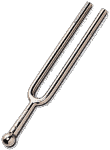
tuning fork

Health care for students at large, urban universities is almost a joy. Top doctors using state of the art equipment provide rapid service at no cost to the students.

The diagnosis of my condition was interesting because it combined very simple diagnostic techniques with techniques requiring numerous sondes and mysterious machines.

Tap on a tuning fork. Place the fork near the ear. Then press the base of the fork against the skull behind the ear. Do you hear a difference in volume? If so, you obviously have some dysfunction in the outer or the middle ear. If not, the problem is farther downstream, in the inner ear, the auditory nerve or the brain.

What about my problem of occasional, intense vertigo? There could be many causes. Techniques like electronystagmography help inform the diagnosis.

And, of course, the traditional hearing tests, checking the hearing of beeps at different frequencies and volumes and checking one’s comprehension of phonemes and words, all play a part in the diagnosis.

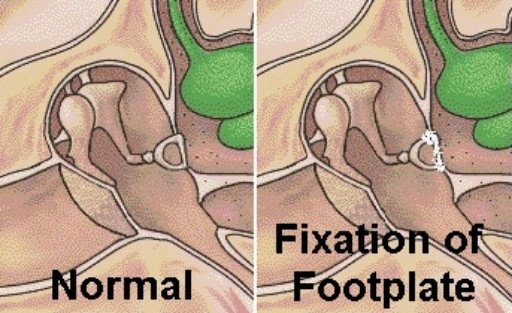
The result was a diagnosis of otosclerosis in both ears with a probable issue with the inner ear in the right ear. Otosclerosis is a stiffening of the stapes in the middle ear due to a bony deposit


Otosclerosis
A comparison of the normal ear with an ear affected by otosclerosis. Note the bony deposits at the base of the stapes. Image based on https://www.wikidoc.org/index.php/Stapedectomy Creative Commons Attribution/Share-Alike License.

The remedies? The classic remedy was the stapedectomy. Otherwise, a hearing aid could be used. No specific diagnosis of the vertigo problem was made, other than to say that it could be a result of the otosclerosis. It was not, for example, a symptom of Ménière’s disease or a brain tumor. Thank heaven for such small mercies.

Thoughts about hearing
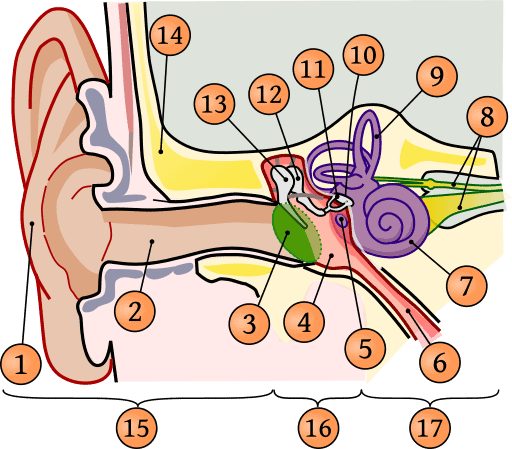
The anatomy of the ear. Based on Chittka L, Brockmann / *derivative work Sgbeer - File:Anatomy of the Human Ear.svg, CC BY 2.5, https://commons.wikimedia.org/w/index.php?curid=17729020

1—Auricle
2—Outer ear
3—Tympanic membrane
4—Tympanic cavity
5—Round window
6—Eustachian tube

7—Cochlea
8—Cochlear nerve/ Vestibular nerve
9—Semicircular canals
10—Round window
11—Stapes

12—Incus
13—Malleus
14—Skull
15—Outer ear
16—Middle ear
17—Inner ear

A stapedectomy is the replacement of the third bone in the middle ear, the stapes (#11), by a prosthesis. The prosthesis is anchored in the inner ear, around the round window (#10) and hooked onto the second bone of the middle ear, the incus (#12). The prosthesis thus transmits the vibrations of sound, which the stapes was failing to do adequately, to the inner ear.

The impact of a diagnosis on my morale was significant. I finally had an idea what was happening to me. I finally had a possible path for treating my condition. In my ignorance of what the future would bring me, I felt as if I had a reprieve.

The Mystery of a New Disease

electronic typewriter

I was finishing up my graduate studies. My dissertation was 98% typed up; I had returned the rented electronic typewriter. (Yes, this was in the days before electronic word processing.)

The department’s secretary kindly allowed me to use a typewriter in her office to finish the typing. As I was typing the last pages, I suddenly felt flushed and increasingly subject to vertigo.

Except for one particularly drunken evening at college, I had never felt my head turn such as it was spinning around. I somehow managed to collect my manuscript and walk home.

The 18 block walk was hellish. I could barely walk straight. How I must have appeared to anyone I passed on the street! I think I vomited twice. I finally arrived home and collapsed on my bed.

The next day I felt completely restored, excepting the disquiet associated with this mysterious attack. Was it food poisoning? Had I contracted some bug? Remember, at this time the Internet was in its infancy and there was no World Wide Web. The plethora of websites advising you on health issues simply did not exist.

As the Germans say, einmal ist keinmal. But this was not to be. Over the next few weeks, I had repeat episodes of that intense vertigo that kept me pinned to my bed. Happily, as I learned in retrospect, these episodes never lasted more than a few hours. But those hours were scary enough. I had no idea what was happening to me. I had no similar experience in my life. I know no one with the same symptoms.

My appointment with the otorhinolaryngologist was fixed.