Health care for students at large, urban universities is almost a joy. Top doctors using state of the art equipment provide rapid service at no cost to the students.
The diagnosis of my condition was interesting because it combined very simple diagnostic techniques with techniques requiring numerous sondes and mysterious machines.
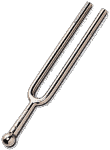
Tap on a tuning fork. Place the fork near the ear. Then press the base of the fork against the skull behind the ear. Do you hear a difference in volume? If so, you obviously have some dysfunction in the outer or the middle ear. If not, the problem is farther downstream, in the inner ear, the auditory nerve or the brain.
What about my problem of occasional, intense vertigo? There could be many causes. Techniques like electronystagmography help inform the diagnosis.
And, of course, the traditional hearing tests, checking the hearing of beeps at different frequencies and volumes and checking one’s comprehension of phonemes and words, all play a part in the diagnosis.
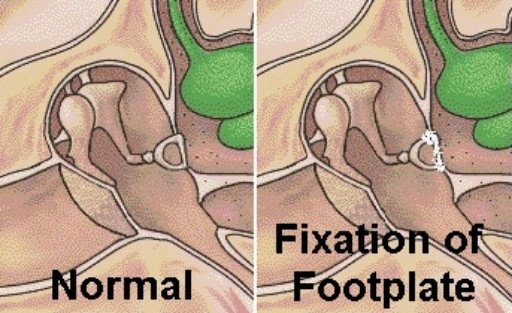
The result was a diagnosis of otosclerosis in both ears with a probable issue with the inner ear in the right ear. Otosclerosis is a stiffening of the stapes in the middle ear due to a bony deposit
A comparison of the normal ear with an ear affected by otosclerosis. Note the bony deposits at the base of the stapes. Image based on https://www.wikidoc.org/index.php/Stapedectomy Creative Commons Attribution/Share-Alike License.
The remedies? The classic remedy was the stapedectomy. Otherwise, a hearing aid could be used. No specific diagnosis of the vertigo problem was made, other than to say that it could be a result of the otosclerosis. It was not, for example, a symptom of Ménière’s disease or a brain tumor. Thank heaven for such small mercies.
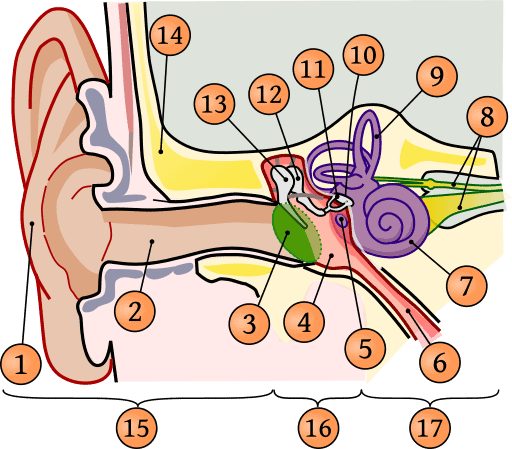
The anatomy of the ear. Based on Chittka L, Brockmann / *derivative work Sgbeer - File:Anatomy of the Human Ear.svg, CC BY 2.5, https://commons.wikimedia.org/w/index.php?curid=17729020
A stapedectomy is the replacement of the third bone in the middle ear, the stapes (#11), by a prosthesis. The prosthesis is anchored in the inner ear, around the round window (#10) and hooked onto the second bone of the middle ear, the incus (#12). The prosthesis thus transmits the vibrations of sound, which the stapes was failing to do adequately, to the inner ear.
The impact of a diagnosis on my morale was significant. I finally had an idea what was happening to me. I finally had a possible path for treating my condition. In my ignorance of what the future would bring me, I felt as if I had a reprieve.
We use cookies to ensure that we give you the best experience on our website. If you continue to use this site we will assume that you are happy with it.Ok