
My level of comprehension had been decreasing noticeably for at least a year. I was completely deaf in my right ear and wholly dependent on my top-of-the-line hearing aid in my left ear. I was 67 years old. I expected to live at least another decade, if not more. But what would happen if my hearing continued to get worse and worse? I could not expect that hearing aid technology would provide a solution.
After exposing this issue to my audiologist, he said, “You’re still young.” I thought, “I’m not so young as that.” But he meant that I was still in good health, strong and young enough to undergo surgery and recover with little difficulty. What surgery? He meant the surgery required for a cochlear implant.
In the past, my doctors had recommended against this sort of solution to my hearing problem. The latest opinion offered was that the quality of hearing via a cochlear implant is not equivalent to the quality offered by a hearing aid.
In the past, I had received such opinions with the thought, “OK, well maybe something else will come up.” But now, my thought changed to “What have I got to lose?” In the past, the memory of my experience following my failed stapedectomy was a vivid reminder of what was at risk. But now, I started to feel that this strong emotional response should be leavened by some objective knowledge.
Until now, all the opinions I had received were from professionals who did not perform cochlear implants. It was time to get the opinion of someone who performed them regularly and worked with patients having been implanted.
I presented my case to the otorhinolaryngologist who performs cochlear implants. On the one hand, my comprehension of speech had been decreasing to the point of making daily life difficult. I was afraid that this difficulty would only get worse. On the other hand, I was concerned about the past issue where the stapedectomy knocked my balance for a loop. I did not want a repeat of that. In short, I had two criteria in my find for deciding whether to pursue a cochlear implant (or any other solution, for that matter):
- Would the solution be likely to improve my comprehension of speech?
- What would be the risk to my sense of balance and the possibility of vertigo?
Naturally, no opinion could be offered about the potential benefits to me of a cochlear implant until a detailed analysis of my current state was made. So, I underwent the standard battery of tests: scans, NMI, hearing tests, balance tests, and so forth. I was spun around in the dark; my ears were filled with hot and cold water; my abysmal comprehension of words out of context was confirmed.
After all the results were in, I consulted the surgeon once again. He opined that I could get significant improvement in my hearing from a cochlear implant. I understand that the surgery itself was only the first step in achieving those benefits. They would depend, too, on the device implanted, on the configuration of that device to meet my needs, and especially on the work I would do, potentially over the course of a year or more, to learn to understand the signals that a cochlear implant could transmit.
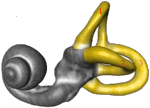
As for the the issue of loss of balance and vertigo, the surgeon felt that there was no significant risk of this happening. The tests showed that the semicircular canals in my right ear no longer contributed to my sense of balance.
The decision was up to me.